AI Fatigue Is Real
Maintaining Human Judgment in an AI-Assisted World
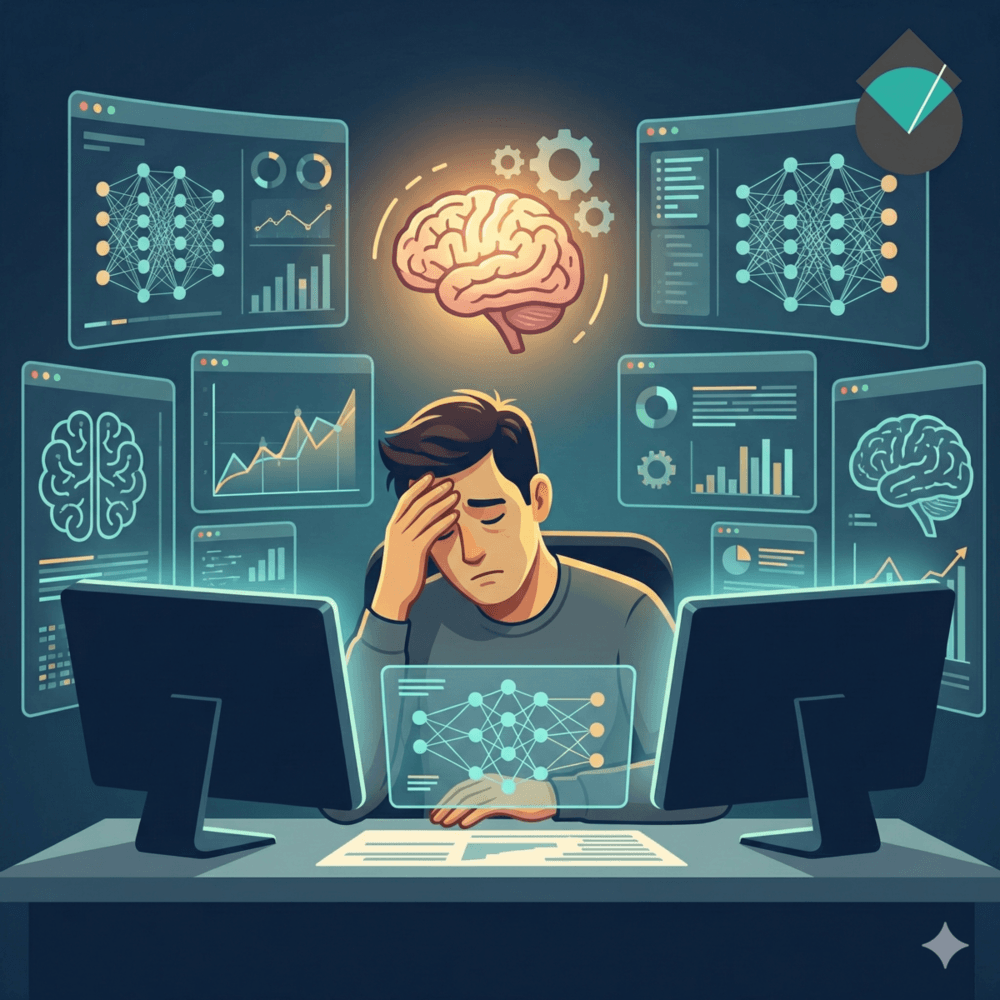
The promise of AI is efficiency: faster analysis, instant drafts, effortless research. But several months into widespread AI adoption, most organizations discover the unexpected cost: AI fatigue.
Not fatigue from AI, but fatigue with AI. The cognitive exhaustion that comes from constant evaluation, verification, and decision-making about AI-generated outputs. It's the mental load of being the human-in-the-loop, every hour of every day.
What AI Fatigue Looks Like
The Verification Burden
Every AI output requires human judgment:
- Is this analysis accurate?
- Did it miss important context?
- Are these recommendations sound?
- Should I trust this conclusion?
Multiply these decisions by dozens of AI interactions daily, and the cognitive load becomes substantial. The very efficiency AI promises creates a new form of decision fatigue.
The Over-Reliance Trap
As fatigue sets in, a dangerous pattern emerges: verification erosion. Teams start accepting AI outputs with less scrutiny, not because they trust the AI more, but because they're exhausted from constant evaluation.
This is when incidents happen. Not from AI failure, but from human judgment failure caused by AI fatigue.
The Always-On Pressure
AI tools are always available, always ready, always suggesting. This creates subtle pressure to always be collaborating, always be optimizing, always be leveraging AI.
The result? Professionals report feeling like they can never fully disengage, even when they should be thinking independently.
Why This Matters for Organizations
Governance Risk
AI fatigue directly undermines governance frameworks. Policies assume humans will maintain consistent judgment and verification standards. But as anyone in safety-focused industries or who's experienced burnout knows, fatigued humans make different decisions than rested ones. This is not a personal failing, it's a systemic one.
The pattern: Morning AI interactions may get thorough review. By afternoon, verification becomes a checklist of "does this look right?" rather than "does this make sense?". By end of day, outputs are too often accepted with minimal scrutiny, if any.
This isn't a training problem. It's a human factors problem.
Quality Degradation
When verification erodes, quality suffers:
- Subtle errors go unnoticed
- Context gaps aren't caught
- Assumptions aren't questioned
- Edge cases aren't considered
The work gets done faster, but the quality degrades incrementally. Often this risk is invisible until a critical failure occurs.
Skill Atrophy Acceleration
AI fatigue accelerates skill atrophy. When you're too tired to verify AI outputs properly, you're also too tired to learn from them. The cognitive engagement required for skill maintenance simply doesn't happen.
Recognizing the Warning Signs
Individual Indicators
Verification shortcuts: Accepting AI outputs with less scrutiny than you did weeks ago
Decision fatigue: Feeling exhausted by the constant need to evaluate AI suggestions
Reduced engagement: Treating AI as an oracle rather than a collaborator
Cognitive offloading: Delegating thinking to AI rather than using it to enhance thinking
Disengagement: Feeling disconnected from your work because AI is doing "the interesting parts"
Team Indicators
Declining quality: More errors making it through review processes
Faster but shallower: Work completed quickly but lacking depth or nuance
Reduced questioning: Team members accepting AI outputs without discussion
Verification variance: Inconsistent standards for AI output review
Burnout signals: Team expressing exhaustion despite AI "efficiency gains"
Building Sustainable Practices
1. Structured AI Interaction
Time-box AI sessions: Limit continuous AI interaction to 90-minute blocks with breaks
Batch verification: Group AI outputs for focused review rather than constant evaluation
Designated AI-free time: Schedule periods for independent thinking without AI assistance
Rotation strategies: For teams, rotate who handles AI-intensive tasks
2. Verification Standards
Checklists over judgment: Create verification checklists to reduce decision fatigue
Tiered review: Match verification depth to output criticality, not to your energy level
Peer verification: For critical outputs, require fresh-eyes review from someone who didn't generate it
Automated checks: Use technical controls to catch common AI errors, reducing human verification burden
3. Cognitive Boundaries
AI-appropriate tasks: Not every task benefits from AI. Some work is better done independently.
Thinking time: Protect time for deep thinking without AI assistance
Skill maintenance: Regularly practice core skills without AI to prevent atrophy
Reflection practices: Build in time to reflect on AI collaboration patterns and adjust
4. Organizational Support
Realistic expectations: Don't assume AI makes everything faster. Factor in verification time.
Workload adjustment: If AI is added to workflows, something else must be removed
Training on fatigue: Help teams recognize and respond to AI fatigue signals
Permission to disconnect: Make it safe to work without AI when appropriate
For Organizational Leaders
Policy Implications
Traditional AI governance policies don't account for human factors like fatigue. Enhanced policies should include:
Verification standards: Clear expectations that don't degrade under fatigue
Workload limits: Maximum AI interactions per day/week before quality review required
Break requirements: Mandatory breaks from AI-intensive work
Rotation policies: Distribute AI-intensive tasks across teams
Quality monitoring: Track output quality over time to detect fatigue-related degradation
Measurement Strategies
Verification consistency: Monitor whether review standards remain consistent throughout the day
Error rates over time: Track whether errors increase as AI usage increases
Self-reported fatigue: Regular check-ins on cognitive load and decision fatigue
Quality variance: Measure whether work quality varies with AI interaction intensity
The Founding Partner Perspective
Organizations in the Founding Partner Program are discovering that sustainable AI adoption requires managing human factors, not just technical capabilities.
Key insights from early partners:
Fatigue is real: Teams report cognitive exhaustion from constant AI evaluation
Verification erosion happens: Quality standards degrade as fatigue sets in
Boundaries matter: Teams with structured AI interaction show better outcomes
Rotation helps: Distributing AI-intensive work prevents individual burnout
Measurement enables intervention: Tracking fatigue signals allows proactive adjustment
Practical Recommendations
For Individuals
- Track your verification quality: Are you reviewing AI outputs as thoroughly at 4pm as at 9am?
- Set AI boundaries: Designate AI-free time for independent thinking
- Use checklists: Reduce decision fatigue with structured verification
- Practice core skills: Regularly work without AI to maintain capabilities
- Monitor your engagement: If you're disengaging from your work, reassess AI usage
For Teams
- Establish verification standards: Clear, consistent expectations for AI output review
- Rotate AI-intensive tasks: Prevent individual fatigue through distribution
- Build in breaks: Structure workflows with AI-free periods
- Monitor quality trends: Track whether quality degrades with AI usage
- Create psychological safety: Make it acceptable to work without AI when appropriate
For Organizations
- Adjust workload expectations: AI doesn't eliminate work, it changes it
- Invest in human factors training: Help teams recognize and manage fatigue
- Measure cognitive load: Track fatigue signals, not just productivity metrics
- Design sustainable workflows: Balance AI efficiency with human sustainability
- Support skill maintenance: Protect time for learning and independent practice
The Path Forward
AI fatigue is not an argument against AI adoption. It's a call for sustainable AI collaboration practices that account for human limitations.
The organizations that will succeed with AI aren't those that maximize AI usage. They're those that optimize the people+AI partnership for both efficiency and sustainability.
This means:
- Recognizing that humans have cognitive limits
- Designing workflows that respect those limits
- Building verification systems that don't rely on constant human vigilance
- Creating cultures where it's safe to work without AI when appropriate
- Measuring success by sustainable outcomes, not just speed
Conclusion
AI fatigue is real, measurable, and consequential. It undermines governance, degrades quality, and accelerates skill atrophy. But it's also manageable through structured practices, organizational support, and honest acknowledgment of human limitations.
The question isn't whether your organization will experience AI fatigue. It's whether you'll recognize it early enough to respond effectively.
Evaluating AI collaboration practices for your organization?
Explore the Founding Partner Program to understand how your teams actually collaborate with AI, including fatigue patterns and verification consistency.
Want to assess your individual AI collaboration patterns?
Take the PAICE assessment to discover your strengths, growth opportunities, and potential over-reliance indicators.
Related Reading
Curious but short on time?
Take the 3-minute PAICE Pulse — a quick confidence check that maps how you see your own AI collaboration posture. No login required.