Improving Your PAICE Score
A Practical Guide to Skill Development
📢 Scoring Update (January 2026): This post references the original 0-100 scoring scale. PAICE now uses a 0-1000 point scale for improved granularity. Score improvements mentioned (e.g., "5-15 points") would now be 50-150 points on the new scale. See PAICE Score™ Changes: What's New in January 2026 for complete details.
After receiving your PAICE score™, the natural question is: "Can I improve?"
The answer is yes, but not overnight. AI collaboration effectiveness is a skill set, and like any skill, it improves with deliberate practice, awareness, and feedback.
This guide provides specific, actionable strategies for improving each dimension of your PAICE score™, along with practice exercises and methods for tracking your progress.
Understanding Skill Development
Before diving into specific strategies, it's important to understand how collaboration skills develop:
Behavioral patterns are relatively stable in the short term. If you retake the assessment tomorrow, your score likely won't change significantly. This isn't because you can't improve, it's because genuine behavior change inevitably takes time.
Improvement requires deliberate practice. Simply using AI more often won't necessarily improve your collaboration effectiveness. You need intentional focus on specific patterns and behaviors.
Awareness is the first step. Understanding your current patterns (especially your blind spots) is essential for targeted improvement.
Dimension-Specific Improvement Strategies
Performance: Communication Efficiency
What Performance Measures: How economically and effectively you communicate with AI—providing appropriate context without over-explaining, framing tasks clearly, and managing conversation flow.
Improvement Strategies
1. Practice the "Context Minimum" Exercise
Before each AI interaction, ask yourself: "What's the minimum context needed for this task?"
- Write down what you think is necessary
- Remove one piece of information
- Test if the AI can still complete the task effectively
- Gradually refine your sense of "just enough" context
2. Use the "One-Sentence Frame" Technique
Practice framing requests in a single, clear sentence before elaborating:
- ❌ "So I'm working on this project and we need to... well, there are several aspects..."
- ✅ "Help me create a project timeline for a 6-month software migration, then I'll provide details."
3. Track Your Prompt Efficiency
Keep a log for one week:
- Initial prompt length (word count)
- Number of clarifying questions AI asks
- Whether you got what you needed on first try
Goal: Reduce clarifying questions while maintaining output quality.
Practice Exercise
The Refinement Challenge: Take a task you completed with AI. Rewrite your initial prompt to be 30% shorter while maintaining all essential information. Test it. Did it work? What did you learn about necessary vs. unnecessary context?
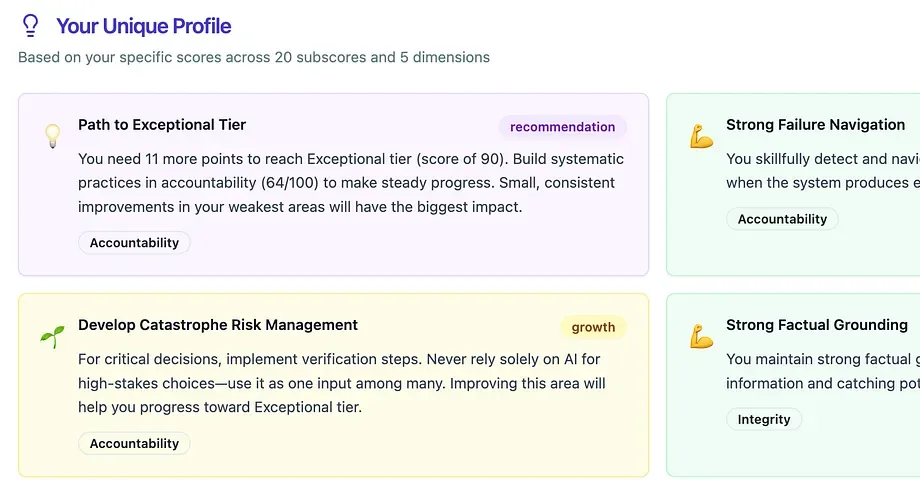
Accountability: Failure Detection and Recovery
What Accountability Measures: Your ability to detect when AI is wrong, incomplete, or uncertain, and how you respond when collaboration breaks down.
This is typically the lowest-scoring dimension—and the most important for risk management.
Improvement Strategies
1. Implement the "Three-Pass Review"
For any AI output you plan to use:
Pass 1 - Plausibility Check: Does this make sense at face value? Pass 2 - Fact Verification: Are specific claims, numbers, or references accurate? Pass 3 - Completeness Check: What's missing? What assumptions were made?
2. Develop Your "Red Flag Radar"
Train yourself to notice warning signs:
- Overly confident language without caveats
- Suspiciously round numbers or convenient statistics
- Generic advice that could apply to anything
- Contradictions within the response
- Missing sources or vague attributions
3. Practice Productive Skepticism
After receiving an AI response, ask yourself:
- "What would I need to verify before using this?"
- "What could be wrong here?"
- "What's the worst-case scenario if this is incorrect?"
Practice Exercise
The Deliberate Error Hunt: Ask AI to help with a task in your domain of expertise. Intentionally look for at least three things to verify or question. Even if the output seems perfect, practice the verification mindset. This builds the habit of active evaluation rather than passive acceptance.
Integrity: Logical Consistency and Factual Grounding
What Integrity Measures: Whether you maintain logical consistency, spot contradictions, and ground outputs in facts rather than plausible-sounding fabrications.
Improvement Strategies
1. Use the "Contradiction Scanner" Method
When reviewing AI outputs:
- Compare statements within the same response
- Check against information from earlier in the conversation
- Verify consistency with known facts in your domain
2. Implement "Source Grounding"
For any factual claim:
- Ask "Where would this information come from?"
- Request sources or citations
- Verify at least one source before accepting the claim
3. Practice the "Alternative Explanation" Technique
When AI provides an explanation or analysis:
- Generate at least one alternative explanation
- Ask AI to evaluate both
- Assess which is better supported by evidence
Practice Exercise
The Consistency Challenge: Have a 10-minute conversation with AI about a topic you know well. Deliberately introduce a contradiction in your third message. Does the AI catch it? Do you notice if it doesn't? This builds awareness of logical consistency.
Collaboration: Iterative Refinement
What Collaboration Measures: How effectively you iterate, refine outputs, and guide improvements without micromanaging.
Improvement Strategies
1. Adopt the "First Draft Mindset"
Never accept the first output as final. Always plan for at least one iteration:
- Initial output → Review → Specific feedback → Refinement
2. Use Specific, Actionable Feedback
Replace vague feedback with specific guidance:
- ❌ "Make it better"
- ❌ "This isn't quite right"
- ✅ "Reduce the technical jargon in paragraphs 2-3"
- ✅ "Add a concrete example after each main point"
3. Practice "Guided Discovery"
Instead of telling AI exactly what to do, guide it toward better solutions:
- "What are three ways we could improve this?"
- "What's missing from this analysis?"
- "How would you strengthen the argument in section 2?"
Practice Exercise
The Three-Iteration Rule: For your next three AI tasks, commit to at least three rounds of refinement, even if the first output seems good. Focus on making each iteration meaningfully better. Track what improves with each round.
Evolution: Meta-Awareness and Adaptation
What Evolution Measures: Whether you demonstrate awareness of AI capabilities and limitations, adapt strategies based on what works, and learn from failures.
Improvement Strategies
1. Keep a "What Worked/What Didn't" Log
After each significant AI interaction, note:
- What approach worked well
- What didn't work as expected
- What you'd do differently next time
- Patterns you're noticing
2. Experiment with Different Approaches
For similar tasks, deliberately try different strategies:
- Different levels of detail in prompts
- Different ways of framing the problem
- Different iteration patterns
3. Reflect on Capability Boundaries
Regularly ask yourself:
- "What is AI good at for this type of task?"
- "Where does it consistently struggle?"
- "How can I structure tasks to play to its strengths?"
Practice Exercise
The Strategy Experiment: Choose a recurring task type. Try three different approaches over three sessions. Document the results. Which worked best? Why? This builds adaptive capability.
Creating Your Improvement Plan
Week 1-2: Awareness Building
Focus: Understanding your current patterns
- Review your PAICE results and recommendations
- Identify your lowest-scoring dimension
- Keep a collaboration journal for all AI interactions
- Note patterns, especially in your weakest area
Week 3-4: Targeted Practice
Focus: Deliberate skill development
- Choose 2-3 specific strategies from your lowest dimension
- Practice them in every AI interaction
- Track your progress in your journal
- Notice what feels natural vs. what requires conscious effort
Week 5-6: Integration and Expansion
Focus: Making improvements habitual
- Continue practicing your initial strategies until they feel automatic
- Add strategies from your second-lowest dimension
- Experiment with different approaches
- Reflect on what's working
Week 7-8: Reassessment
Focus: Measuring progress
- Retake the PAICE assessment
- Compare results to your initial score
- Review your journal for pattern changes
- Adjust your improvement plan based on results
Tracking Your Progress
Quantitative Metrics
Conversation Efficiency:
- Average prompt length
- Number of iterations to satisfactory output
- Clarifying questions from AI
Verification Habits:
- Percentage of outputs you verify
- Number of errors caught before use
- Time spent on verification
Iteration Quality:
- Number of refinement rounds per task
- Improvement between iterations
- Specificity of feedback provided
Qualitative Indicators
Awareness Shifts:
- Noticing things you previously missed
- Catching yourself in old patterns
- Recognizing AI limitations proactively
Behavior Changes:
- Automatic verification habits
- Natural iteration patterns
- Adaptive strategy selection
Common Improvement Challenges
"I'm Not Seeing Progress"
Possible causes:
- Not enough time has passed (behavior change takes weeks, not days)
- Practicing in low-stakes situations only
- Not tracking specific behaviors
- Focusing on too many dimensions at once
Solutions:
- Focus on one dimension for 2-3 weeks
- Practice with real, consequential tasks
- Keep detailed logs of specific behaviors
- Be patient with the process
"My Score Went Down"
This can happen and doesn't mean you're regressing:
- You might be more aware of what you don't know
- You might be experimenting with new approaches
- Natural variation in assessment conditions
- Different task complexity
Response: Review your journal. Are your actual behaviors improving, even if the score doesn't reflect it yet? Trust the process.
"I Don't Have Time for All This"
Start smaller:
- Pick ONE strategy from your lowest dimension
- Practice it for just 5 minutes daily
- Use tasks you're already doing
- Build gradually
The Long Game
Improving your PAICE score™ isn't about gaming the assessment—it's about developing genuine collaboration effectiveness that makes you more productive, reduces risk, and helps you get better results from AI tools.
Realistic expectations:
- 1 month: Noticeable awareness improvements, some behavior changes
- 2-3 months: Measurable score improvements (typically 5-15 points)
- 6 months: Significant capability development, new habits established
- 1 year: Substantial transformation in collaboration effectiveness
The goal isn't perfection, it's continuous improvement. Even small gains in collaboration effectiveness compound over time, especially in high-stakes or high-frequency AI use.
Your Next Steps
- Review your PAICE results and identify your lowest-scoring dimension
- Choose 2-3 strategies from that dimension to focus on
- Start your collaboration journal today
- Practice deliberately for 30 days
- Reassess and adjust your approach
Remember: The fact that you're reading this guide means you're already demonstrating Evolution—meta-awareness and commitment to improvement. That's the foundation for all other skill development.
Ready to establish your baseline? Take the PAICE assessment to understand your current collaboration patterns and identify specific areas for improvement.
Recommended Reading
📖 Understanding Your Score:
- What Your PAICE Score Really Means (And What It Doesn't) - Interpret your results effectively
- The PAICE Framework: Five Dimensions of AI Readiness - Deep dive into each dimension
📖 Structured Development:
- From Novice to Proficient: A 30-Day AI Collaboration Development Plan - Day-by-day improvement roadmap
- Building Your AI Collaboration Toolkit - Essential tools and practices
📖 Avoiding Pitfalls:
- Common AI Collaboration Mistakes (And How to Avoid Them) - Learn from common errors
Curious but short on time?
Take the 3-minute PAICE Pulse — a quick confidence check that maps how you see your own AI collaboration posture. No login required.