What Your PAICE Score™ Means
And What It Doesn't
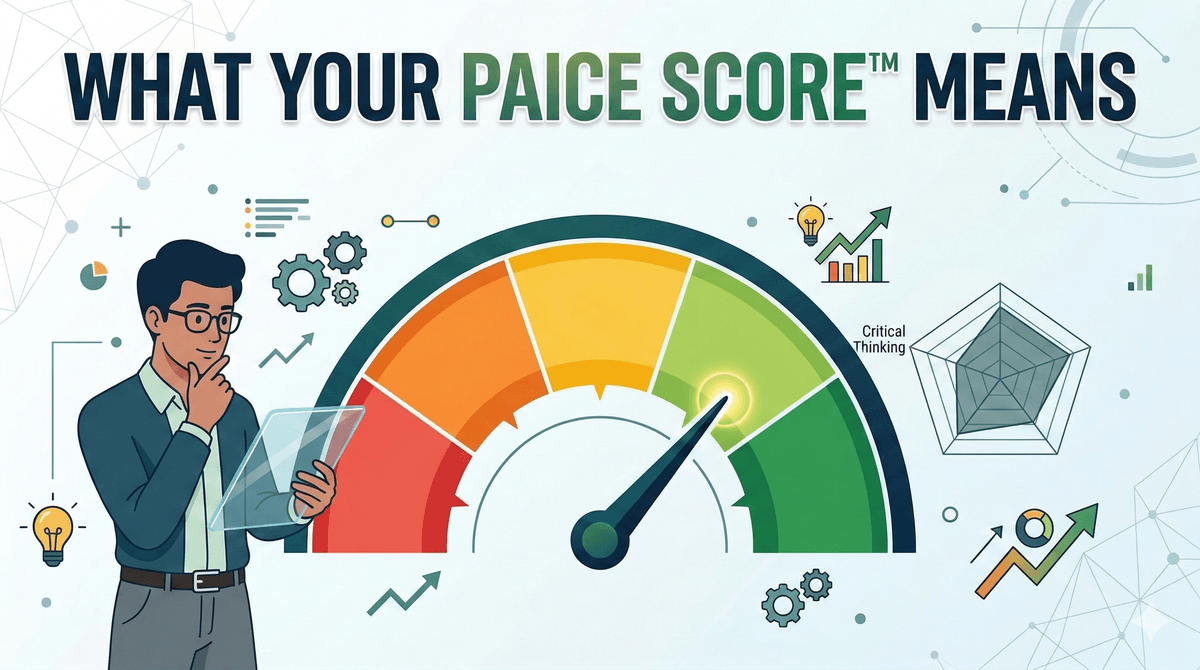
You've completed the PAICE (People + AI Collaboration Effectiveness) assessment and received your score. But what does that number actually mean? More importantly, what doesn't it mean? Let's break down how to interpret your results and use them effectively.
Understanding the 0-1000 Scale
Your PAICE Score™ is measured on a 0-1000 scale. This isn't like a traditional test where 700 means you got 70% of questions right. Instead, your score reflects observed collaboration effectiveness across twenty behavioral indicators that roll up to five core dimensions.
The Calibration Framework
The scale represents a spectrum of collaboration capability:
- 0 = Actively hostile or non-cooperative with AI systems
- 1000 = World-class AI collaboration on a best day
Most people score between 200 and 400 on their first assessment. This isn't because they're bad at their jobs — it's because AI collaboration is a genuinely new skill that most people haven't deliberately developed. Your first score is a baseline, not a verdict.
The Five Tiers
Your score places you in one of five tiers, each representing a distinct level of collaboration capability:
Constrained (0-299)
What it means: Significant barriers to effective AI collaboration are present. These might include:
- Limited understanding of AI capabilities and limitations
- Difficulty framing effective requests
- Minimal verification of AI outputs
- Resistance to iterative refinement
- Lack of systematic approaches to collaboration
What it doesn't mean: You're "bad" at your job. Many highly capable professionals score in this range simply because they haven't yet developed AI-specific collaboration skills. Domain expertise and AI collaboration readiness are separate things.
What to do: Focus on foundational skills — understanding how AI works, learning basic prompting techniques, and developing verification habits. See Improving Your PAICE Score for dimension-specific strategies.
Informed (300-499)
What it means: Basic collaboration capability with room for growth. You can:
- Use AI for straightforward tasks
- Recognize obvious errors in AI output
- Iterate when prompted to refine results
- Understand basic AI limitations
What it doesn't mean: You're "average." This tier represents functional capability. You can work with AI, but there are significant opportunities to become more effective and more resilient to AI errors.
What to do: Develop more sophisticated prompting strategies, strengthen verification practices, and learn to handle more complex collaboration scenarios.
Proficient (500-699)
What it means: Solid collaboration practices with some blind spots. You demonstrate:
- Effective prompting across various task types
- Systematic verification approaches
- Good error detection most of the time
- Productive iteration patterns
- Understanding of context management
What it doesn't mean: You've "mastered" AI collaboration. There are still areas where you could improve, particularly in edge cases, high-stakes situations, or when AI is confidently wrong.
What to do: Identify and address your specific blind spots. Your dimensional breakdown will show you exactly where to focus.
Advanced (700-899)
What it means: Strong collaboration capability with self-correcting practices. You show:
- Sophisticated prompting strategies
- Proactive error detection
- Effective recovery from AI failures
- Adaptive approaches based on context
- Meta-awareness of your own collaboration patterns
What it doesn't mean: You're done growing. Even advanced collaborators have areas for development, and the AI landscape evolves constantly.
What to do: Focus on edge cases, develop expertise in domain-specific AI collaboration, and consider helping others improve their skills.
Exceptional (900-1000)
What it means: Exceptional collaboration effectiveness across all dimensions. You demonstrate:
- Expert-level communication with AI systems
- Highly developed error detection and verification
- Sophisticated recovery strategies
- Deep understanding of AI capabilities and limitations
- Consistent excellence across diverse scenarios
What it doesn't mean: You can't improve. Even exceptional scores have room for growth, particularly as AI technology evolves and new capabilities emerge.
What to do: Share your expertise, contribute to best practices in your organization, and reassess periodically — your score has a 6-month half-life.
What PAICE Measures (And What It Doesn't)
What PAICE Measures
Observable behavioral patterns in AI collaboration:
- How you frame requests and provide context
- How you respond to AI outputs — especially when they contain errors
- How you iterate and refine toward better results
- How you detect and recover from failures
- How you maintain critical judgment when AI sounds confident
The critical distinction: conversation is the medium, but it is not what's being measured. PAICE measures how you respond to AI behavior — including failures, overconfidence, and hallucinations — in real time.
What PAICE Doesn't Measure
Intelligence: Your PAICE Score™ is not an IQ test. Highly intelligent people can score low if they haven't developed AI collaboration habits. You don't need to be a genius to score high — you need effective collaboration patterns.
Domain expertise: PAICE doesn't measure how much you know about your field. A world-class expert might score low if they haven't learned to collaborate effectively with AI.
Technical knowledge about AI: You don't need to understand how neural networks work to score high. PAICE measures practical collaboration skills, not theoretical knowledge.
Personality traits: This isn't a personality assessment. Your score reflects learned behaviors, not innate characteristics.
Overall job performance: AI collaboration is one skill among many. A lower PAICE Score™ doesn't mean you're not good at your job — it means you have an opportunity to develop this specific capability.
Understanding Your Results
Your Overall Score
Your overall PAICE Score™ (0-1000) is a weighted combination of five dimensional scores:
| Dimension | Weight | What It Measures |
|---|---|---|
| Performance | 10% | Getting useful outputs from AI |
| Accountability | 30% | Verifying outputs, catching errors, maintaining ownership |
| Integrity | 25% | Ethical awareness, bias recognition, fact-checking |
| Collaboration | 20% | Iterative refinement and effective partnership |
| Evolution | 15% | Learning, adapting, and improving your approach |
Accountability carries the highest weight (30%) because the human remains responsible for the outcome. Your ability to catch AI errors before they cause problems is the most critical — and most underdeveloped — collaboration skill.
For the full calculation methodology, see How Is My PAICE Score Calculated?
Your Dimensional Profile
The dimension breakdown is often more valuable than the overall score. It shows you exactly where to focus your development.
A score of 545 with strong Collaboration (600) but weak Accountability (380) tells a very different story than the same overall score with the opposite pattern. The first profile suggests someone who works well with AI but doesn't catch enough errors. The second suggests someone who's vigilant about verification but could improve how they interact with AI.
For a deep dive into what each dimension measures and what distinguishes high performers, see Understanding the Five PAICE Dimensions.
Your History Page
Your History page tracks your development over time:
- Compare to your baseline: See how each dimension has changed since your first assessment
- Visualize trends: Track progress across multiple assessments
- Identify patterns: Understand which dimensions improve fastest and which need more attention
- Derive insights: Get personalized recommendations based on your assessment history
Score Half-Life
Your PAICE Score™ has a 6-month half-life. After six months without reassessment, your score's relevance diminishes by half. This reflects reality:
- AI tools and capabilities evolve rapidly
- Collaboration patterns can drift without active attention
- Skills that aren't practiced tend to atrophy
- The AI landscape you're navigating changes constantly
We recommend reassessment every 30-60 days for those actively developing their skills, and at least every 6 months for everyone else. See Can I Retake the Assessment? for guidance on timing and preparation.
Common Misinterpretations
"I scored low, so I'm bad at AI"
No. You might be effective at specific AI tasks while having gaps in your overall collaboration capability. The score reveals opportunities for growth, not fundamental inadequacy. Most first-time scores fall between 200 and 400.
"I scored high, so I don't need to improve"
No. Even exceptional scores have room for growth. AI technology evolves rapidly, and collaboration best practices are still being established. The 6-month half-life exists for a reason.
"My score is lower than my colleague's, so they're better than me"
No. Different people have different dimensional profiles. Your colleague might score higher overall but have weaknesses in areas where you're strong. Focus on your own development, not comparison.
"This score will determine my career"
No. PAICE is a development tool, not a credential. It's designed to help you improve, not to label or limit you. Your results belong to you — we don't share them with anyone, even employers.
"I just need to learn better prompts"
Not quite. Performance (prompting ability) is only 10% of your score. The dimensions that matter most - Accountability (30%) and Integrity (25%) — are about what you do after AI gives you an answer. Do you verify? Do you catch errors? Do you maintain professional judgment? Slightly more important than what you know today is how fast you can learn new things, because AI models change rapidly. This is why Evolution is weighted at (15%), above Performance.
How to Use Your Score Effectively
Focus on Your Dimensional Breakdown
Don't fixate on the overall number. Your five dimension scores tell you exactly where to invest your development effort. Start with your lowest-weighted-impact dimension — usually Accountability or Integrity — since these have the largest effect on your overall score.
Read Your Personalized Insights
Your results include specific observations about your collaboration patterns. These are more actionable than the score itself.
Create a Development Plan
Use your results to create a focused plan. Don't try to improve everything at once. Pick one or two dimensions to work on first. See Improving Your PAICE Score for dimension-specific strategies, or follow the 30-Day AI Collaboration Development Plan for a structured approach.
Track Your Progress
Use your History page to see how your scores change over time. Meaningful improvement typically takes 2-4 weeks of deliberate practice. We recommend waiting at least 15 days between assessments to allow behavioral patterns to genuinely change.
Remember What Matters
Your PAICE Score™ is a measurement tool, not the goal itself. What matters is whether you can verify AI outputs effectively, catch errors before they cause problems, iterate toward better results, and maintain appropriate professional judgment. If those capabilities are improving, your score will follow.
The Bottom Line
Your PAICE Score™ is a tool for development, not a judgment. It reflects your current collaboration capability based on observed behaviors, and it provides a roadmap for improvement.
What matters most isn't the number — it's what you do with the insights.
A score of 350 with a commitment to improvement is more valuable than a score of 750 with complacency. Use your results to identify opportunities, develop new skills, and become more effective at AI collaboration.
This is a snapshot of where you are today, not a prediction of where you'll be tomorrow. With awareness, practice, and systematic development, you can significantly improve your AI collaboration capability.
Ready to understand your own collaboration profile? Take the PAICE assessment to get detailed insights and personalized recommendations for development.
Recommended Reading
📖 Understanding the Framework:
- Understanding the Five PAICE Dimensions - What each dimension measures and what distinguishes high performers
- How Is My PAICE Score Calculated? - The scoring formula, weights, and calculation methodology
- Why Your Accountability Score Is Probably Lower Than Your Other Dimensions - Understanding the most challenging dimension
📖 Taking Action:
- Improving Your PAICE Score: A Practical Guide - Dimension-specific improvement strategies
- Can I Retake the Assessment? - Timing, preparation, and making retakes count
- From Novice to Proficient: A 30-Day AI Collaboration Development Plan - Structured roadmap for skill development
Curious but short on time?
Take the 3-minute PAICE Pulse — a quick confidence check that maps how you see your own AI collaboration posture. No login required.