What Makes PAICE Different from Other Assessments?
Behavioral observation vs. self-reporting in AI collaboration assessment
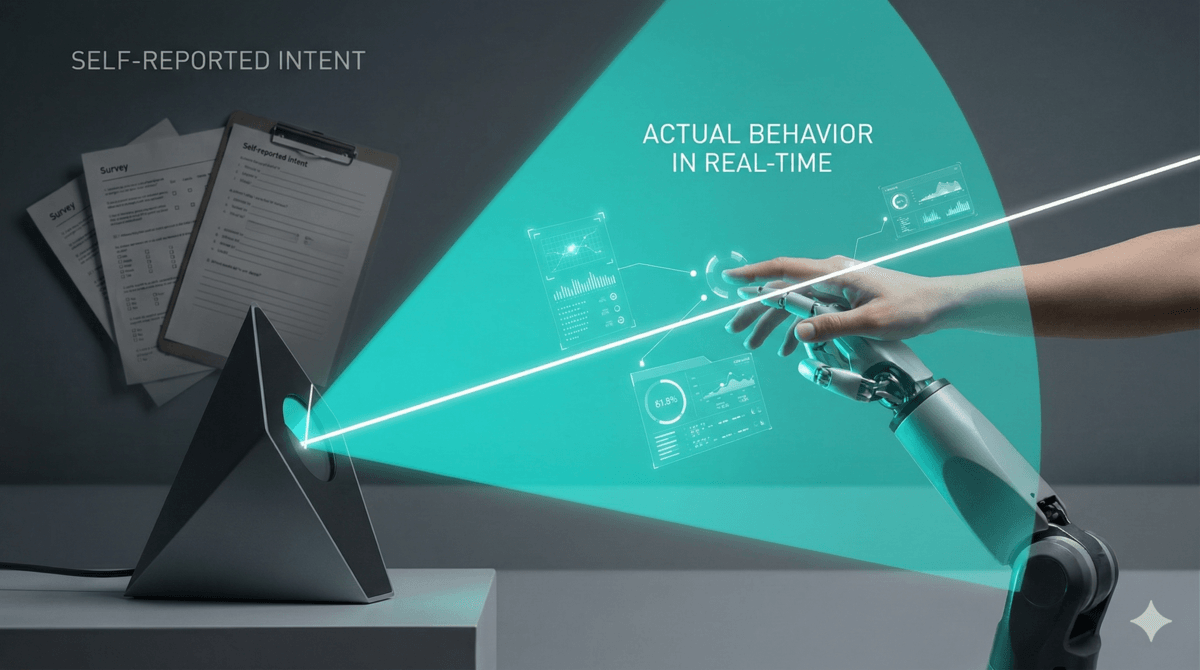
Question: "What makes PAICE different from other AI assessments?"
Short answer: PAICE observes actual behavior during real AI collaboration, rather than asking you to self-report what you think you do or know.
The Self-Reporting Problem
Traditional Assessment Approach
Most AI assessments follow a familiar pattern:
- Present multiple-choice questions about AI concepts
- Ask users to rate their own skills or behaviors
- Generate scores based on self-reported responses
- Provide generic recommendations
Example questions:
- "How often do you verify AI outputs?" (Always/Sometimes/Rarely/Never)
- "Rate your AI prompting skills" (1-5 scale)
- "Do you understand AI limitations?" (Yes/No)
Why This Doesn't Work
The knowledge-behavior gap: Knowing what you should do doesn't predict what you actually do under pressure.
Social desirability bias: People answer how they think they should behave, not how they actually behave.
Dunning-Kruger effect: Those least skilled rate themselves highest; experts rate themselves critically.
No verification: Self-reports can't be validated against actual behavior.
The PAICE Approach: Behavioral Observation
How It Works
Instead of asking what you do, PAICE observes what you actually do:
- Real task: You work on an actual task using AI
- Natural collaboration: You interact with AI as you normally would
- Behavioral observation: PAICE analyzes your collaboration patterns
- Evidence-based scoring: Results based on demonstrated behavior, not self-reports
What PAICE Observes
- Prompting patterns and iteration
- Verification behaviors
- Error handling and adaptation
- Information management
- Critical thinking vs. over-reliance
Key difference: Captures authentic, unconscious patterns in real work context—verifiable and defensible for governance.
Key Differentiators
1. No Preparation Needed
Bring a real task. No studying required. We measure how you actually work, not test-taking ability.
2. Model-Agnostic Design
Works with Claude, ChatGPT, Gemini, or other models. Collaboration patterns transfer across tools.
3. Privacy-First Architecture
Zero personal data collection, no system integrations, conversation content not stored. Perfect privacy score (100/100).
4. Governance-Ready Artifacts
Provides behavioral risk profiles, verification failure patterns, accountability gap analysis, and audit-ready documentation (not just one-dimensional scores).
5. Strategic Failure Injection
Deliberately introduces challenges (incomplete information, subtle errors) to test failure navigation, not just success scenarios.
6. Weighted Accountability
Accountability weighted 30% vs. 10-25% for other dimensions, reflecting that the biggest AI risks come from accountability failures.
What PAICE Doesn't Do
Not a knowledge test: We measure what you do, not what you know about AI concepts.
Not a tool tutorial: We measure collaboration capability, not tool proficiency.
Not a certification program: We measure current capability for development and governance, not for credentialing.
Not a surveillance system: Privacy-by-design means assessment only happens when you choose to participate.
For Organizations: Why This Matters
Defensible Evidence: Behavioral observation provides documented methodology and audit-ready artifacts when regulators ask "How do you know your people use AI safely?"
Risk Identification: Surfaces unconscious over-reliance, verification blind spots, and accountability gaps that self-reports miss.
Targeted Intervention: Identifies specific capability gaps for targeted training and resource allocation.
Organizational Benchmarking: Consistent methodology enables reliable comparison across cohorts and longitudinal tracking.
Common Comparisons
vs. Knowledge Quizzes: Quizzes test what you know. PAICE measures how you collaborate.
vs. Self-Assessment Surveys: Surveys ask you to rate yourself. PAICE observes actual behavior.
vs. Tool Certifications: Certifications prove tool proficiency. PAICE measures transferable collaboration patterns.
vs. Compliance Checklists: Checklists verify policy acknowledgment. PAICE measures whether people are actually introducing risk with how they use AI.
Research Foundation
PAICE's approach is grounded in behavioral psychology (observation predicts behavior better than self-reports), human factors engineering (real-world performance reveals capabilities abstract tests miss), and risk management (actual behavior under stress differs from intended behavior).
Practical Implications
For Individuals: 25-minute conversation with AI about a real task. No preparation needed.
For Teams: Cohort-level behavioral insights for targeted training and risk identification.
For Organizations: Audit-ready documentation with 3-10 day procurement, no system integrations.
The Bottom Line
PAICE is different because it measures what actually matters: how people actually collaborate with AI, not how they think they do or how well they can answer questions about it.
This distinction matters for:
- Accuracy: Behavioral observation is more predictive than self-reports
- Governance: Defensible evidence vs. survey responses
- Risk management: Identifies unconscious patterns that self-reports miss
- Organizational value: Actionable insights vs. generic recommendations
If you need to know how your teams actually use AI, rather than how they say they use it, behavioral observation is the only reliable approach.
Ready to see how your team actually collaborates with AI?
Explore the Founding Partner Program for organizational assessment, or take the individual assessment to experience behavioral observation firsthand.
Related Reading
Curious but short on time?
Take the 3-minute PAICE Pulse — a quick confidence check that maps how you see your own AI collaboration posture. No login required.