How Is My PAICE Score Calculated?
Understanding the five dimensions and what shapes your score
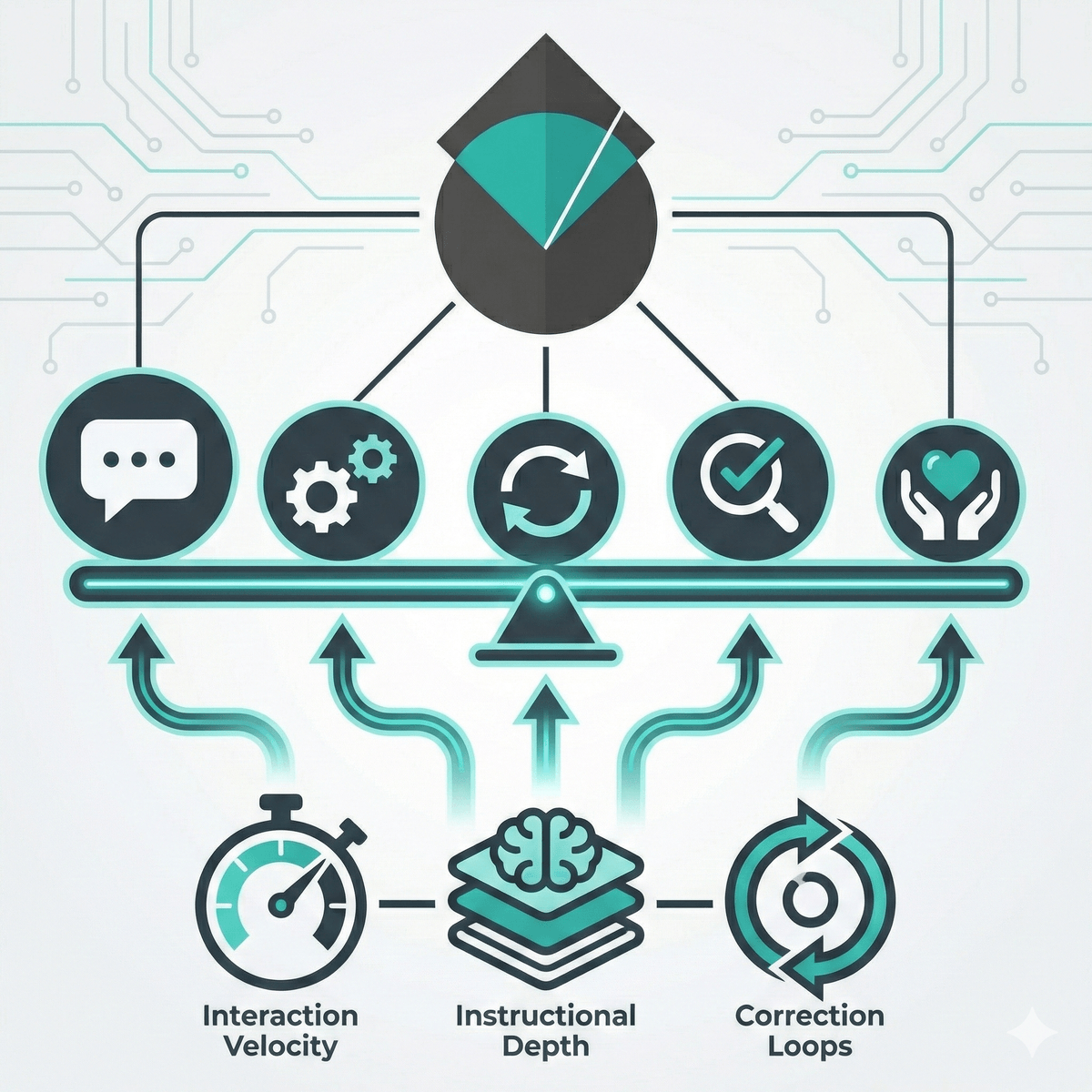
Question: "How is my PAICE score calculated?"
Short answer: Your PAICE score is a weighted combination of five dimensions (Performance, Accountability, Integrity, Collaboration, and Evolution), each measuring different aspects of how you work with AI. The assessment observes your actual collaboration patterns during a real task, not your knowledge about AI.
The Five Dimensions and Their Weights
Your overall PAICE score (0-1000) is built from five distinct dimensions:
| Dimension | Weight | What It Measures |
|---|---|---|
| Performance | 10% | Getting useful outputs from AI |
| Accountability | 30% | Verifying outputs and maintaining ownership |
| Integrity | 25% | Ethical awareness and bias recognition |
| Collaboration | 20% | Iterative refinement and partnership |
| Evolution | 15% | Learning and adapting your approach |
For a deeper dive into what each dimension measures and what distinguishes high performers, see Understanding the Five PAICE Dimensions.
The Scoring Formula
Each dimension produces a subscore (0-1000), and these are combined using the weights above:
Overall Score = (Performance × 0.10) + (Accountability × 0.30) +
                (Integrity × 0.25) + (Collaboration × 0.20) +
                (Evolution × 0.15)
Example Calculation
If your dimension scores were:
- Performance: 650
- Accountability: 480
- Integrity: 550
- Collaboration: 600
- Evolution: 520
Your overall score would be:
(650 × 0.10) + (480 × 0.30) + (550 × 0.25) + (600 × 0.20) + (520 × 0.15)
= 65 + 144 + 137.5 + 120 + 78
= 544.5 → 545
This weighted approach means that strong Accountability and Integrity scores have more impact on your overall score than strong Performance alone.
Why These Weights?
The weights reflect what matters most for responsible, effective AI collaboration in professional settings.
Why Accountability Is Weighted Highest (30%)
Accountability carries the most weight because the human remains responsible for the outcome. AI systems can:
- Produce confident-sounding errors
- Miss context that changes everything
- Hallucinate facts or citations
- Reflect biases in their training data
Your ability to catch these issues before they cause problems is critical. This is where organizational risk lives, and why verification habits matter more than raw prompting ability.
Why Performance Is Weighted Lowest (10%)
Performance measures whether you can get useful outputs from AI. While important, it's the most learnable dimension and the least predictive of responsible AI use. Someone can be highly effective at prompting AI while still lacking the verification habits (Accountability) or ethical awareness (Integrity) that prevent problems.
Think of it this way: Performance is your raw power. The other dimensions determine whether you can direct that power responsibly.
The Middle Three (Integrity 25%, Collaboration 20%, Evolution 15%)
These dimensions capture the judgment, partnership skills, and adaptability that separate competent AI users from truly effective collaborators. They're weighted to reflect their importance in real-world outcomes while acknowledging that Accountability remains the critical differentiator.
What the Assessment Observes
During your 20-25 minute assessment, PAICE observes how you naturally collaborate with AI on a real task you choose. The assessment doesn't test your knowledge about AI, it observes your behavior with it.
Behavioral Patterns, Not Individual Actions
PAICE measures patterns, not individual actions. A single verification check doesn't determine your Accountability score, your consistent approach to verification does.
This means:
- Consistency matters: Sporadic good behavior doesn't compensate for habitual gaps
- Natural patterns emerge: Over 20-25 minutes, your authentic collaboration style shows through
- Gaming is difficult: Performing behaviors you don't naturally do is hard to sustain authentically
The assessment is designed to reveal how you actually work with AI, not how you think you should work with AI.
What Gets Observed in Each Dimension
For each dimension, the assessment tracks specific behavioral indicators:
Performance: Communication clarity, context provision, task framing, result quality
Accountability: Verification frequency, error detection, recovery actions, ownership signals
Integrity: Bias awareness, fact-checking, ethical reasoning, transparency about AI's role
Collaboration: Iteration patterns, feedback specificity, refinement strategies, partnership mindset
Evolution: Strategy adaptation, learning from results, meta-awareness, experimentation
For detailed examples of what high performers do differently in each dimension, see Understanding the Five PAICE Dimensions.
What PAICE Doesn't Measure
Understanding what's not in your score is just as important:
Not measured:
- Your intelligence or general capability
- Your domain expertise or job knowledge
- How much you know about AI technology
- Your typing speed or technical fluency
- Whether you use the "right" AI tools
- The specific task you choose for assessment
Why this matters: A brilliant expert in their field might score lower than expected if they haven't developed AI-specific collaboration habits. Conversely, you don't need to be a technical expert to score well, you need effective collaboration patterns.
Understanding Your Results
When you receive your score, you'll see:
- Overall score (0-1000): Your weighted combination across all dimensions
- Tier placement: Where you fall on the capability spectrum (Constrained through Exceptional)
- Dimension breakdown: Your score in each of the five areas
- Confidence interval: The precision of your measurement (e.g., ±50 points)
- Personalized insights: Specific observations about your collaboration patterns
The dimension breakdown is often more valuable than the overall score. It shows you exactly where to focus your development efforts. A score of 545 with strong Collaboration (600) but weak Accountability (480) tells a very different story than the same overall score with the opposite pattern.
Why Behavioral Assessment?
Traditional assessments often measure knowledge, what you know about a topic. PAICE measures capability, which is what you actually do when collaborating with AI.
This behavioral approach:
- Reflects real-world effectiveness: Knowing best practices doesn't help if you don't apply them
- Identifies genuine gaps: You might not realize you skip verification until it's measured
- Guides meaningful development: Dimension scores show exactly where to improve
- Resists gaming: You can't cram for behavioral patterns the way you can for knowledge tests
Building Trust Through Transparency
We believe you should understand how these measurements work. While we don't reveal every detail of our methodology (to preserve assessment validity), we're committed to transparency about:
- What dimensions we measure and why
- How those dimensions are weighted
- What types of behaviors we observe
- How scores are calculated from observations
This transparency helps you interpret your results meaningfully and focus your development where it matters most.
Your Score Is a Starting Point
Your PAICE score isn't a judgment, it's a diagnostic tool. It shows you:
- Where you are today
- Which dimensions need attention
- What patterns might be holding you back
- Where your strengths lie
The goal isn't to achieve a specific number. It's to calibrate your self-perception to your skill level, and to develop genuine AI collaboration capability that makes you more effective in real work.
Most people score between 200-400 on their first assessment. This isn't because they're bad at their jobs, it's because AI collaboration is a genuinely new skill that most people haven't deliberately developed. Your score is a baseline, not a verdict. Most people see meaningful improvement in their first 1-3 months of focused practice.
Ready to see your dimension breakdown? Take the PAICE assessment to discover your strengths and growth areas across all five dimensions.
Related Reading
- Understanding the Five PAICE Dimensions - Deep dive into what each dimension measures and what high performers do differently
- What Your PAICE Score Really Means (And What It Doesn't) - Understanding tiers and interpretation
- Why Your Accountability Score Is Probably Lower Than Your Other Dimensions - The hardest dimension explained
- Improving Your PAICE Score: A Practical Guide - Dimension-specific improvement strategies
- PAICE Score™ Changes: What's New in January 2026 - The 1000-point scale explained
Curious but short on time?
Take the 3-minute PAICE Pulse — a quick confidence check that maps how you see your own AI collaboration posture. No login required.