Understanding the Five PAICE Dimensions
What each dimension reveals about your AI collaboration capability
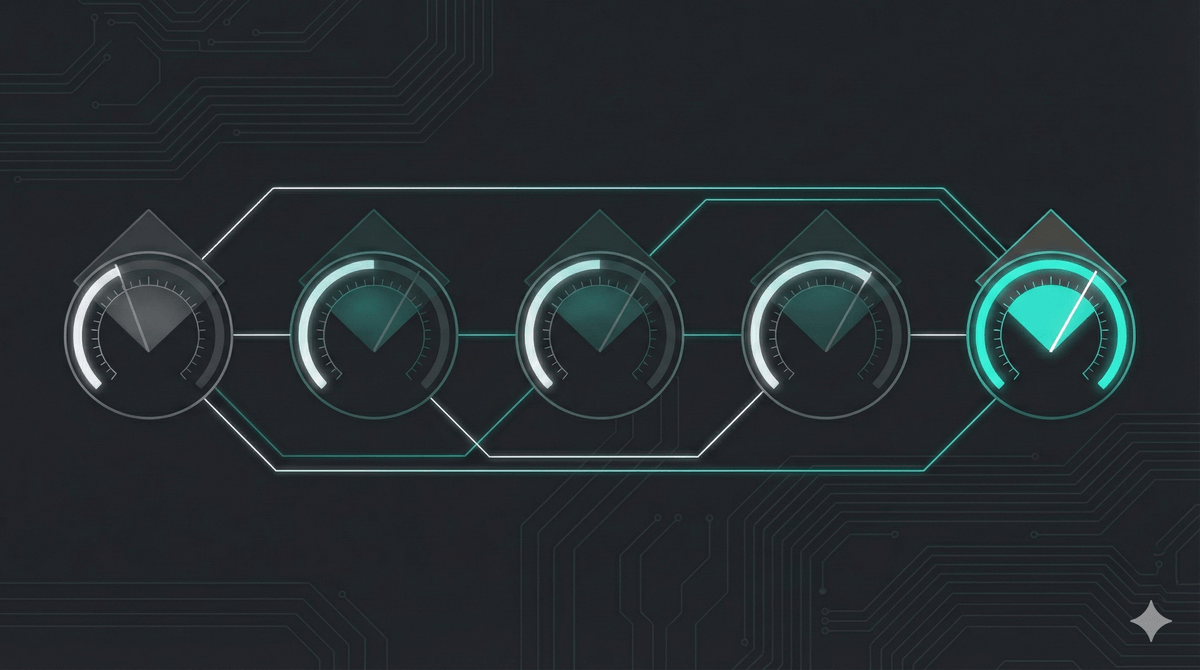
The PAICE framework measures AI collaboration readiness across five dimensions:
- Performance
- Accountability
- Integrity
- Collaboration
- Evolution
You may notice that this also reinforces the "PAICE" acronym, though our company "PAICE.work" is actually named after our framework "People + AI Collaboration Effectiveness" and that came first.
While our introductory post provides an overview, this deeper dive explores what each dimension actually measures, why it matters, and what separates high performers from those still developing their skills.
Performance (10% of your score)
What It Measures
Performance captures your ability to communicate effectively with AI and achieve useful results. This includes:
- Clarity of communication: Can you frame requests in ways AI can act on?
- Context provision: Do you give enough information without overwhelming?
- Efficiency: Can you get good results without excessive back-and-forth?
- Task completion: Do your AI collaborations produce usable outputs?
What High Performers Do Differently
They front-load context strategically. Rather than dumping everything they know or providing nothing, high performers identify the minimum context needed for the task and provide it upfront. They've developed an intuition for what AI needs to know.
They frame tasks, not just requests. Instead of "Write me an email," they say "Help me draft a professional email declining a meeting invitation while maintaining the relationship. I'll give you the context." This framing helps AI understand the goal, not just the action.
They recognize when to start over. Sometimes a conversation goes off track. High performers notice this quickly and restart with a better approach rather than trying to salvage a confused thread.
Why It's Weighted at 10%
Performance is the most learnable dimension. Anyone can improve their prompting skills relatively quickly with practice. But Performance is also the least predictive of responsible AI use. Someone can be excellent at getting outputs while still lacking the verification habits or ethical awareness that prevent problems.
Think of Performance as table stakes. You need it, but it's not what distinguishes truly effective AI collaborators.
Signs You're Developing
- You're getting useful outputs on the first or second try more often
- AI asks fewer clarifying questions
- You've developed go-to approaches for common task types
- You can explain why certain prompts work better than others
Accountability (30% of your score)
What It Measures
Accountability is your ability to maintain ownership of AI-assisted work. This includes:
- Verification habits: Do you check AI outputs before using them?
- Error detection: Can you spot when AI is wrong, incomplete, or uncertain?
- Recovery capability: When things go wrong, can you identify and fix the problem?
- Ownership clarity: Do you take responsibility for the final result?
What High Performers Do Differently
They treat AI outputs as drafts, not deliverables. High performers never use AI output without review. They've internalized that AI can be confidently wrong, and they've built verification into their workflow.
They have systematic verification approaches. Rather than vaguely "checking" outputs, they have specific methods: fact-checking claims, testing code, cross-referencing sources, asking probing follow-up questions.
They catch errors proactively. High performers notice warning signs—overly confident language, suspiciously convenient statistics, generic advice, missing caveats—and investigate before problems occur.
They know their verification limits. They recognize when they lack the expertise to verify something and seek appropriate review rather than assuming it's correct.
Why It's Weighted at 30%
Accountability carries the highest weight because it's where organizational risk lives. AI systems can produce impressive and believable sounding errors. Without strong verification habits, those errors make it into final deliverables, decisions, and communications.
This is also the dimension where most people score lowest. We're naturally inclined to trust confident-sounding information, and AI provides no verbal cues of uncertainty. Developing genuine skepticism while maintaining productivity is genuinely difficult.
Signs You're Developing
- You automatically question AI outputs rather than accepting them
- You've caught errors that would have caused problems
- You have go-to verification methods for different types of content
- You can articulate what you verified and why
Integrity (25% of your score)
What It Measures
Integrity captures your ethical awareness and commitment to accuracy. This includes:
- Bias recognition: Can you identify when AI outputs might be biased?
- Factual grounding: Do you ensure outputs are based on facts, not plausible fabrications?
- Ethical reasoning: Do you consider the broader implications of AI-assisted work?
- Honest representation: Are you transparent about AI's role in your work?
What High Performers Do Differently
They actively scan for bias. High performers don't assume AI outputs are neutral. They consider whose perspectives might be missing, what assumptions are embedded, and whether the output would be appropriate for all stakeholders.
They keenly detect internal inconsistency. AI can confidently wander off-topic or contradict itself. High performers have learned to recognize that confident language doesn't indicate self-referential integrity - they look for logical gaps, missing context, or contradictory statements.
They consider downstream effects. Before using AI-assisted work, they think about who will be affected and whether the output could cause harm if it's wrong or biased.
They're transparent about AI involvement. When appropriate, they disclose AI's role in their work. They don't misrepresent AI-generated content as entirely their own when that would be misleading.
Why It's Weighted at 25%
Integrity matters because AI can amplify both good and bad outcomes. Biased outputs can perpetuate discrimination. Fabricated information can damage reputations and decisions. Lack of transparency can erode trust.
As AI becomes more integrated into consequential decisions, the ability to maintain ethical standards becomes increasingly critical. This isn't just about following rules, it's about exercising judgment in situations where the rules haven't been written yet.
Signs You're Developing
- You notice potential biases in AI outputs
- You catch and steer AI outputs rather than assuming integrity
- You consider who might be affected by AI-assisted work
- You're comfortable discussing AI's role in your work
Collaboration (20% of your score)
What It Measures
Collaboration captures how effectively you work with AI as a partner. This includes:
- Iterative refinement: Can you guide AI toward better outputs through feedback?
- Productive dialogue: Do you engage in genuine back-and-forth rather than one-shot requests?
- Feedback quality: Is your feedback specific and actionable?
- Partnership mindset: Do you treat AI as a collaborator rather than a vending machine?
What High Performers Do Differently
They plan for iteration. High performers never expect the first output to be final. They approach AI collaboration as a process of iterative refinements, not a single transaction.
They give specific, actionable feedback. Instead of "make it better" or "this isn't quite right," they say "reduce the jargon in paragraph two" or "add a concrete example after each main point." This specificity helps AI improve meaningfully.
They use guided discovery. Rather than dictating exactly what to do, they ask questions: "What are three ways we could strengthen this argument?" "What's missing from this analysis?" This leverages AI's capabilities while maintaining human direction.
They know when to push and when to pivot. Sometimes iteration improves outputs; sometimes you need a different approach entirely. High performers recognize the difference and adjust accordingly.
Why It's Weighted at 20%
Collaboration matters because AI's value often emerges through dialogue, not single exchanges. The ability to guide AI toward better outputs and to iterate productively determines whether you get mediocre results or excellent ones.
This dimension also reflects a mindset shift. Those who treat AI as a tool to be commanded often get worse results than those who treat it as a partner to be guided. The collaboration mindset unlocks AI's potential.
Signs You're Developing
- You naturally iterate rather than accepting first outputs
- Your feedback has become more specific over time
- You've developed effective refinement patterns for common tasks
- You can guide AI to outputs you couldn't have specified upfront
Evolution (15% of your score)
What It Measures
Evolution captures your capacity to learn and adapt your AI collaboration practices. This includes:
- Meta-awareness: Do you understand AI's capabilities and limitations?
- Adaptive strategies: Do you adjust your approach based on what works?
- Learning from failure: Do you improve after things go wrong?
- Future orientation: Are you preparing for AI's evolving role?
What High Performers Do Differently
They reflect on what works. High performers don't just use AI, they reflect on their AI use. They notice patterns, identify effective strategies, and consciously refine their approaches.
They experiment deliberately. Rather than using the same approach every time, they try different strategies and compare results. This experimentation builds a repertoire of effective techniques.
They learn from failures. When AI collaboration goes wrong, high performers analyze what happened and adjust. They don't just move on—they extract lessons.
They stay current. AI capabilities evolve rapidly. High performers stay informed about new developments and adjust their mental models accordingly.
Why It's Weighted at 15%
Evolution matters because AI collaboration is a moving target. The strategies that work today may not work tomorrow. The ability to learn, adapt, and improve ensures your skills remain relevant as technology advances. That's why it's worth slightly more than your Performance score today.
This dimension also predicts long-term success. Someone with strong Evolution capabilities will continue improving, while someone without them is likely to plateau or fall behind as AI changes.
Signs You're Developing
- You can articulate what AI is good and bad at for your work
- You've changed your approach based on experience
- You learn from both successes and failures
- You stay curious about AI developments
How the Dimensions Work Together
The five dimensions aren't independent, they reinforce each other:
- Performance without Accountability leads to efficient production of unchecked errors
- Accountability without Performance means catching errors in outputs that weren't useful anyway
- Integrity without Collaboration limits your ability to refine biased outputs
- Collaboration without Evolution means repeating the same approaches even when they stop working
- Evolution accelerates improvement across all other dimensions, most notably Performance
The most effective AI collaborators develop strength across all five dimensions, not just one or two.
Your Development Path
Understanding these dimensions helps you focus your improvement efforts:
- Identify your lowest dimension from your PAICE results
- Understand what that dimension measures (use this guide)
- Recognize what high performers do differently in that area
- Practice deliberately with specific strategies
- Reassess to measure progress
The goal isn't perfection in any dimension, it's continuous improvement across all five. Even small gains compound over time, especially in high-stakes or high-frequency AI use.
Ready to understand your dimensional profile? Take the PAICE assessment to see how you score across all five dimensions, or review How Is My PAICE Score Calculated? to understand how these dimensions combine into your overall score.
Related Reading
- The PAICE Framework: Five Dimensions of AI Readiness - Overview of the framework
- How Is My PAICE Score Calculated? - Dimension weights and scoring
- Why Your Accountability Score Is Probably Lower Than Your Other Dimensions - Deep dive on the hardest dimension
- Improving Your PAICE Score: A Practical Guide - Dimension-specific improvement strategies
- What Your PAICE Score Really Means - Understanding tiers and interpretation
Curious but short on time?
Take the 3-minute PAICE Pulse — a quick confidence check that maps how you see your own AI collaboration posture. No login required.